
Aluminum Custom Machined Belt Sander Pulley
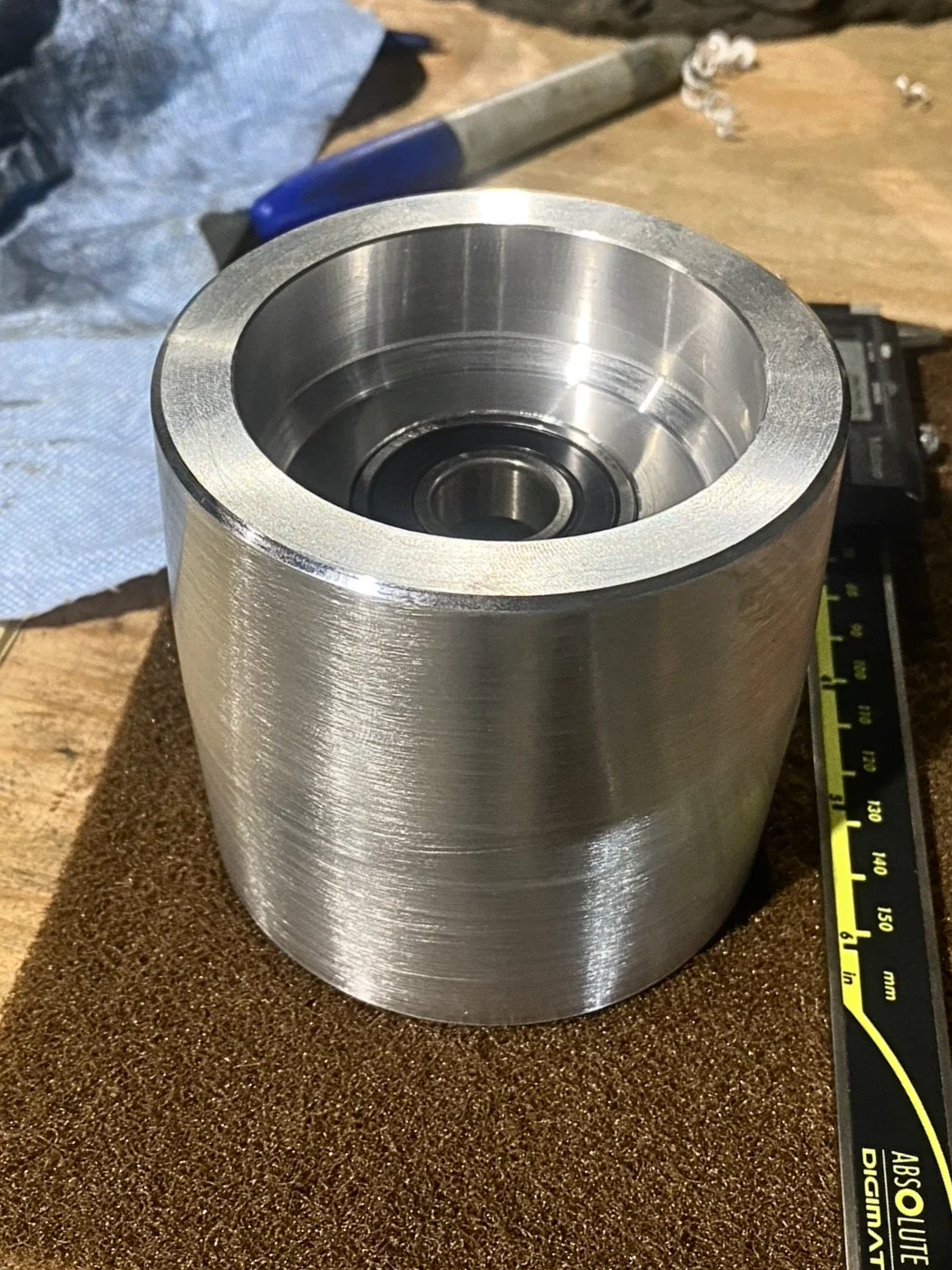
This aluminum pulley was machined as part of a custom belt sander build.
When people think about a belt sander, the sanding belt usually gets most of the attention. If the belt won't stay centred or the machine vibrates more than it should, it's easy to assume the belt is the problem.
In reality, the pulley has a significant influence on how the machine performs. It helps guide the belt, supports smooth rotation, and becomes part of a system where even relatively small machining errors can affect how the machine feels to operate. For a custom machine, finding a pulley that is "close enough" usually doesn’t cut it. A standard pulley may have the wrong diameter, the wrong width, or a bore that doesn't match the shaft it needs to fit. Rather than changing the rest of the machine to accommodate an off-the-shelf part, this pulley was machined specifically for the application it was intended for.
Belt Sander Pulley Performance Requirements
Although it appears to be a fairly straightforward component, the pulley does much more than just rotate with the drive system. As the belt travels around the machine, the pulley helps keep it moving in a consistent path and supports the belt under load while allowing power from the motor to be transferred through the drive system.
To perform properly, the pulley needs to:
rotate concentrically
fit the shaft correctly
support the belt evenly across its width
maintain consistent contact with the belt throughout rotation
work with the remaining components in the machine
If any one of these factors is off, the effects can often be noticed elsewhere in the machine.
Belt Tracking Starts With the Entire System
When a sanding belt begins drifting toward one side, replacing the belt isn't always the answer. Tracking is influenced by several parts working together, including the pulleys, bearings, frame alignment, belt tension, and tracking adjustment- and the pulley is one piece of that system.
If pulleys aren’t machined accurately or don’t match the application at hand, the machine may become more difficult to adjust and less predictable in operation. That said, it doesn't necessarily mean the pulley is the only problem- but it does mean it's one of the first components worth evaluating when a custom machine is being built or repaired.
Why Custom Pulleys Are Sometimes Necessary
Standard pulleys are designed to suit common shaft sizes and common applications, which can pose a problem for custom equipment that isn’t built using custom dimensions.
A custom machine may require a pulley with:
specific outside diameter
custom face width
non-standard bore
particular keyway size
unique hub design
Trying to modify multiple components to fit a standard pulley can quickly become more work and time consuming than custom manufacturing a pulley that already fits the machine.
Custom machining allows the finished component to match the equipment instead of asking the equipment or operator to adapt to the component.
Machining Accuracy Makes a Difference
A pulley doesn't need to be complicated to influence how a machine performs- if it doesn't run concentrically, the machine may develop unnecessary vibration. On the other hand, unintended movement or behaviour can can develop over time if the shaft doesn’t fit the pulley well or if the running surface isn’t machined consistently. None of these issues are pose major problems on their own, but together, they can affect how smoothly and consistently it performs over time.
For that reason, machining a pulley is about more than producing the correct shape. The finished component needs to function properly once it's installed.
This pulley was manufactured from aluminum, a material commonly used in custom machinery because it machines well, resists corrosion, and provides a good balance of strength and weight for a variety of applications.
The right material for a given job always depends on how the component will be used- and skilled machinists do not take a “one-size-fits all” approach- but aluminum is often a practical choice for rotating components where unnecessary weight is more of a disadvantage.
Why Aluminum Was Used
Why Getting the Small Details Right Matters
A pulley isn't usually the most expensive or most noticeable part of a machine, and it may not come up in routine maintenance inspections or maintenance for a while once it’s installed- and that’s usually a good sign
When manufactured accurately, fitted correctly, and built to suit the application, the operator should spend more time using the machine than adjusting it. This goal is ultimately what custom machining is intended to achieve.
Frequently Asked Questions
-
In many cases, yes. If the original pulley is available, it can often be measured and evaluated so a replacement can be manufactured to suit the application. Depending on the condition of the original part, it may also be possible to make small improvements while maintaining compatibility with the rest of the machine.
-
Sometimes that's a practical solution. In other situations, modifying an off-the-shelf pulley can end up taking more time than manufacturing one with the correct dimensions from the start. The right approach depends on the machine, the application, and how many other components would need to be altered to make the standard pulley fit.
-
It can. While the motor supplies the power and the sanding belt does the work, the pulley helps guide the belt and supports smooth rotation throughout the system. If it isn't suited to the application or isn't machined accurately, it can contribute to tracking issues, vibration, and unnecessary belt wear.
-
Because it's usually influenced by more than one component. Tracking can be affected by pulley geometry, bearing condition, machine alignment, belt tension, and the overall condition of the machine. Solving the problem often means looking at how those parts work together instead of focusing on one component in isolation.
Related Services
Custom machining for replacement components, rotating equipment, prototypes, tooling, and machine modifications.
Purpose-built tooling and custom equipment manufactured around the way the finished machine will actually be used.
From individual machined parts to complete assemblies built around unique equipment requirements.
Similar Projects
The structural foundation of the same custom belt sander build, machined to establish the geometry for every major component.
A rotating mechanical component manufactured to restore proper engagement within an existing drive system.
Custom shop tooling built to improve rigidity, blade support, and machining consistency.
Shop tooling manufactured to improve workpiece support during turning operations.
Let’s Get Started on Your Project
Need a replacement pulley manufactured for an existing machine, or a custom pulley for a new build?
Send photos, drawings, dimensions, or details about the application through this secure form. We'll review the project, determine whether custom machining is a practical solution, and get back to you as soon as we possibly can.