
Custom Machined Slitting Saw Arbor
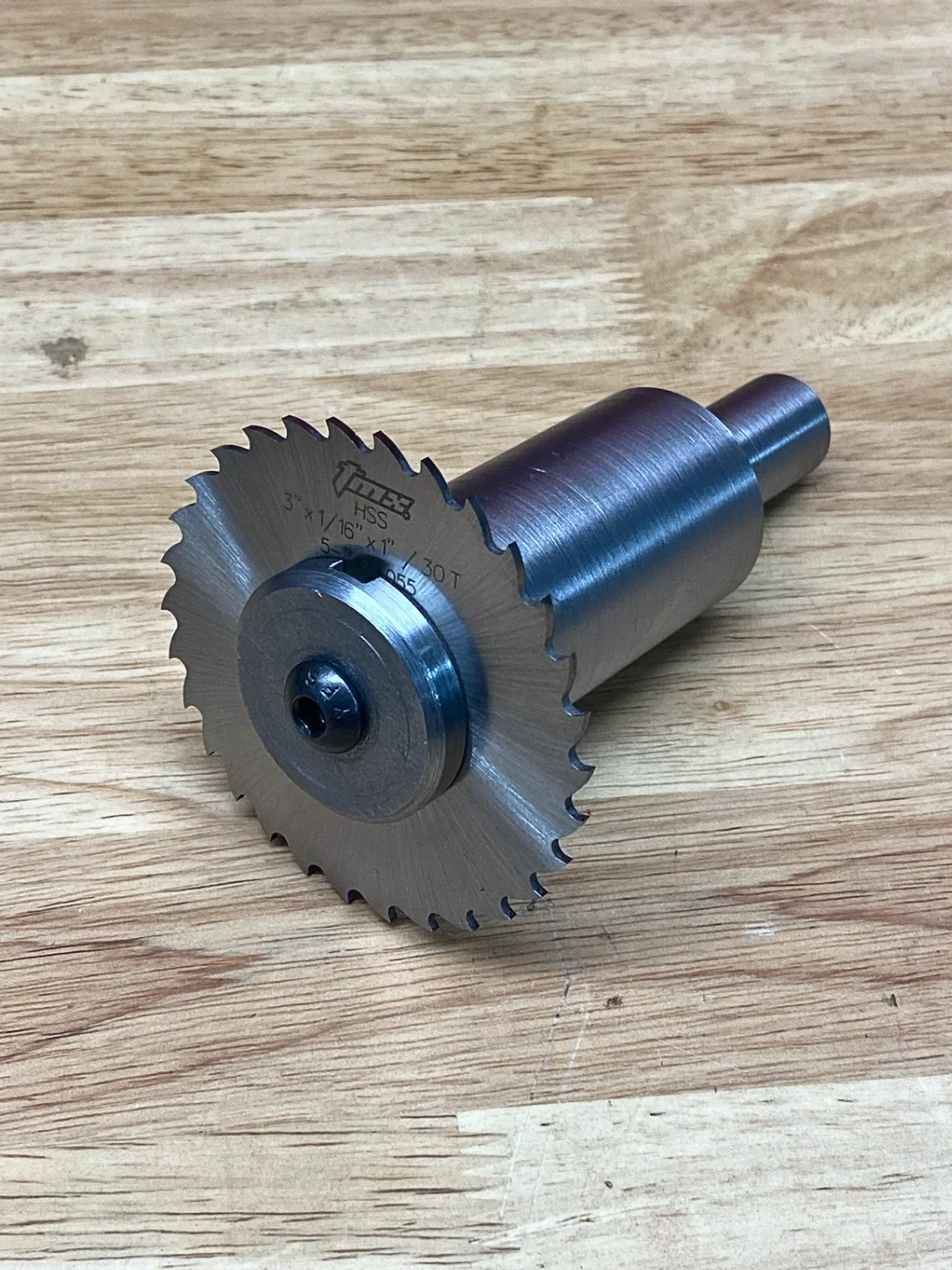
This custom slitting saw arbor was machined in-house for precision cutting operations.
When people think about slitting saws, attention usually goes to the cutting blade itself. Blade selection matters, but even a high-quality blade can struggle to produce accurate results if it isn't being supported properly. The arbor is responsible for locating and supporting the blade throughout the cut. If it doesn't run true, clamp the blade securely, or fit the machine correctly, the effects will most likely become visible in the finished work rather than in the arbor itself.
This project involved manufacturing a slitting saw arbor designed to provide reliable blade support for precision applications
Why the Arbor Matters Just as Much as the Blade
A slitting saw blade is only as stable as the arbor supporting it. Unlike many milling cutters, slitting saws are relatively thin. That makes them more sensitive to movement during machining and less forgiving of setup issues that may go unnoticed with more rigid tooling.
The arbor's job is to securely support the blade while transmitting rotational force from the spindle without introducing unnecessary movement.
To fulfil this job successfully, the arbor needs to:
support the blade securely
maintain concentricity during rotation
minimize runout
resist deflection under cutting loads
position the blade consistently every time it's installed
If one of these factors isn't being met, improving cutting performance often actually starts with the setup and not the cutter itself.
Thin Cutters Leave Less Room for Error
Not every machining operation demands the same level of setup accuracy, but because slitting saw blades are relatively thin, small problems in setup can become noticeable much faster than they would with larger or more rigid cutting tools. That’s why improving the setup is often just as important as selecting the correct blade.
Depending on the application, insufficient blade support or poor setup may contribute to any of the following issues:
inconsistent slot widths
vibration during cutting
poor surface finish
accelerated cutter wear
reduced dimensional accuracy
Runout may often be talked about as though it's isolated to the arbor itself, but that's rarely where the effects stop.
If the arbor doesn't rotate concentrically, that movement is transferred directly to the cutter. The result may be wider cuts than expected, inconsistent dimensions, increased cutter wear, or additional vibration. While runout can certainly have more than one cause, the arbor is one of the first components worth evaluating because it establishes how the blade rotates right from the start.
Runout Doesn’t Stay at the Arbor
Consistency Makes Tooling Valuable
A good shop tool doesn't just work once- it works in the exact same way each time it's used.
When an arbor locates the blade consistently and supports it properly from one setup to the next, operators spend less time making corrections. This predictability is one of the reasons custom tooling can become such a valuable part of a machine shop, particularly for repeat jobs.
Frequently Asked Questions
-
Commercial arbors work well for many machining applications, but they aren't always the right fit for every machine or every job. A custom arbor may be manufactured when standard tooling doesn't provide the correct dimensions, spindle compatibility, or blade support required for the application.
-
Yes. The arbor is responsible for supporting and locating the blade throughout the cut. If it doesn't run true or doesn't support the blade properly, it can contribute to vibration, inconsistent slot widths, poor surface finish, and premature cutter wear.
-
Vibration can have several causes, including runout, poor blade support, incorrect cutting parameters, worn machine components, or an unstable setup. Because several factors can produce similar symptoms, it's important to evaluate the machining setup as a whole rather than assuming the blade itself is at fault.
Related Services
Precision machining for tooling, fixtures, replacement parts, and production equipment across a wide range of industries.
Manufacture shop tooling designed around the specific work your equipment performs.
Custom-machined solutions supporting new equipment builds, prototypes, and production improvements.
Similar Projects
Purpose-built tooling designed to improve workpiece support and machining consistency.
Precision rotating component manufactured for smooth operation within a custom-built machine.
Machine structure establishing accurate locations for bearings, shafts, and rotating assemblies.
A custom-machined assembly manufactured specifically for a specialized piece of equipment.
Let’s Get Started on Your Project
Need a custom shop tooling manufactured for a specific machining application?
Send photos, sketches, dimensions, drawings, or details about the project through this secure form. We'll review the application, determine whether a custom-machined solution is a practical option, and get back to you as soon as we possibly can.