
Custom Hydraulic Cylinder Stem and Piston Assembly
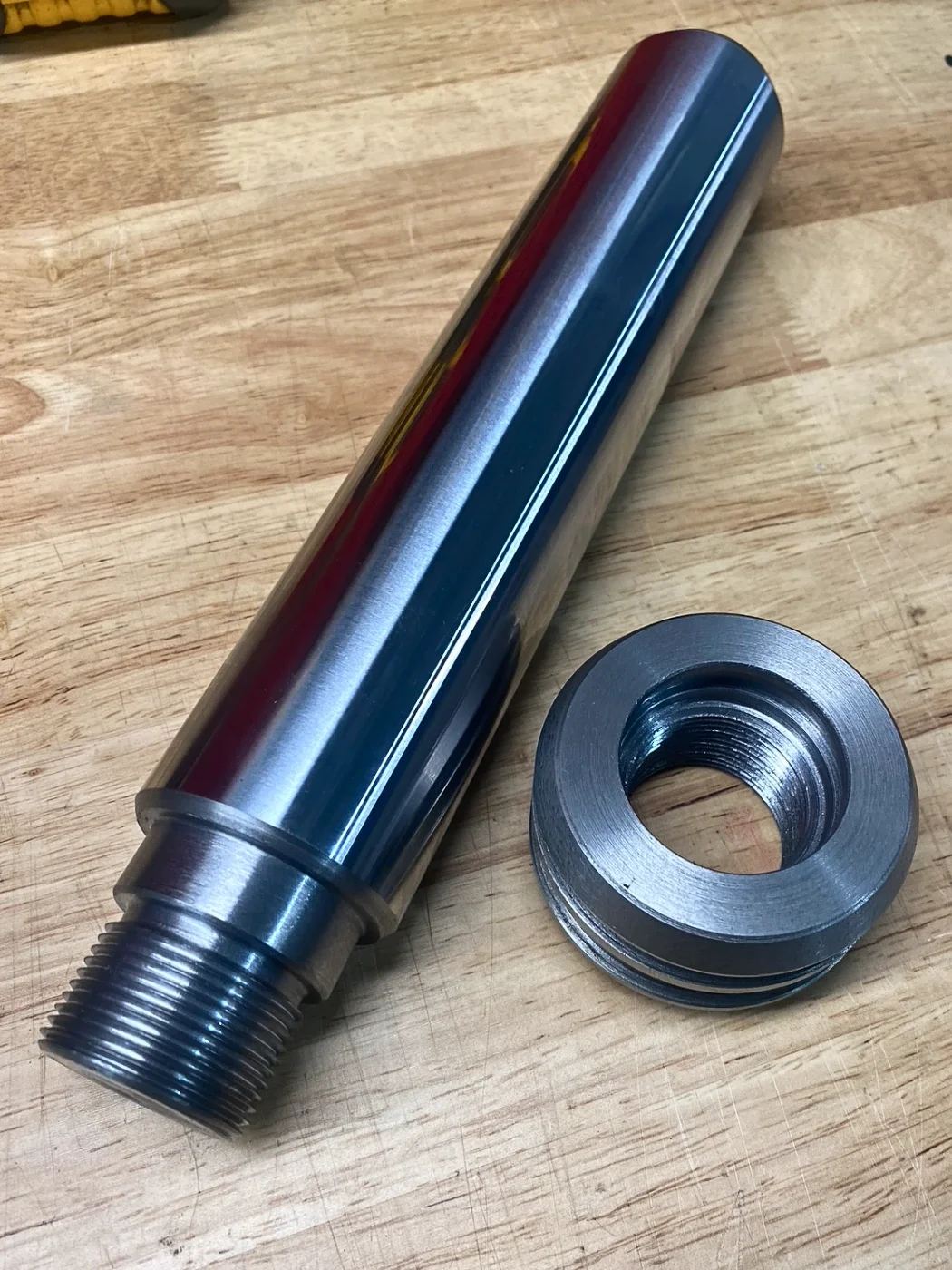
This custom hydraulic cylinder stem and piston assembly was manufactured for a hydraulic cylinder rebuild that required replacing more than a single internal component.
When a hydraulic cylinder begins leaking or losing performance, it's natural to want to focus on the first failed part that you come across. A damaged piston, worn stem, or failed seal often becomes the immediate repair, but in many cases, those visible failures may only be a part of a larger underlying.
This project involved manufacturing both the stem and piston as a matching assembly, instead of pairing a new component with another one that's already experienced years of wear.
Hydraulic Repairs Often Begin with a Symptom
Hydraulic cylinders operate under repeated loading over thousands of operating cycles, with the internal components influencing one another as they wear. As such, damage that begins in one area can eventually affect another, making it important to evaluate the cylinder as a complete assembly before deciding which components should be repaired or replaced.
That doesn't mean every repair requires multiple new parts. It does mean the condition of each component should be considered before assuming only one has reached the end of its service life.
How the Stem and Piston Need to Work Together
Although they perform different jobs, the stem and piston are directly connected throughout the cylinder's operation.
The piston converts hydraulic pressure into linear force, while the stem transfers that force to the machine or attachment being operated. As they move through the cylinder together, they're also working with the gland, seals, and barrel to maintain alignment and contain hydraulic pressure.
For reliable operation, the assembly needs to maintain the following relationships to prevent premature wear or performance decline:
transfer hydraulic force efficiently
support proper sealing
maintain alignment throughout the stroke
move smoothly within the cylinder
distribute operating loads as intended
Manufacturing a stem and piston together isn't simply about replacing two worn components.
Manufacturing the stem and piston together also means the relationship between the two components can be established before the cylinder is ever reassembled. What may seem like an extra step becomes particularly important when working with older equipment, previous repairs, or hydraulic cylinders where replacement parts are no longer readily available.
Rather than treating each component as a separate job, the assembly should be manufactured with the understanding that every internal part still needs to work together once the cylinder is put back into operation.
Manufacturing the Assembly Instead of Individual Parts
Working from the Cylinder Instead of the Catalogue
When a hydraulic cylinder is disassembled, there's an opportunity to look beyond an obvious failed component in the assembly and evaluate how the remaining components have worn together over time.
The thing is, not every hydraulic repair begins with part numbers or engineering drawings. A lot of the time, the cylinder itself provides all the information needed to manufacture replacement components. Existing parts can be measured, inspected, and compared to identify wear, confirm critical dimensions, and better understand how the original assembly functioned before the rebuild to prevent surprises during installation and testing.
Sometimes, this evaluation confirms only one part needs replacing, while other times, manufacturing a matching assembly provides a better long-term repair because the components are built to work together from the start.
Frequently Asked Questions
-
This depends on the condition of the existing components. If inspection shows wear, damage, or dimensional changes affecting both parts, replacing them as a matching assembly can often make more sense than replacing only one while hoping the other continues to perform as intended.
-
Often, yes. Older equipment frequently remains mechanically sound with proper maintenance even after replacement parts have become difficult or impossible to source. Existing components can often be measured and evaluated so a replacement assembly can be manufactured to suit the cylinder being repaired.
-
Not always. Seals are a common cause of leakage, but they're only one part of the assembly. If the stem, piston, or other internal components have also worn over time, replacing the seals alone may not fully address the underlying problem.
-
Although they're separate components, they're designed to work together throughout the cylinder's operating cycle. Manufacturing them as a matching assembly helps ensure the critical dimensions and fit between the two components are established from the beginning rather than relying on parts with different manufacturing histories or wear patterns.
Related Services
Precision machining for tooling, fixtures, replacement parts, and production equipment across a wide range of industries.
Manufacture replacement hydraulic and other industrial components that help restore worn equipment to service.
Similar Projects
A hardened chrome hydraulic rod manufactured for demanding mobile equipment applications.
Replacement gland manufactured to guide the rod while supporting the hydraulic sealing system.
Hydraulic support components manufactured to improve line routing and protect hydraulic systems.
Let’s Get Started on Your Project
Need replacement hydraulic cylinder components manufactured for a repair or rebuild?
Whether you're replacing a single internal part or rebuilding an entire hydraulic assembly, send photos, measurements, drawings, or details about the cylinder through this secure form. We'll review the application and let you know whether custom machining is a suitable approach for your repair.